
Many of the floors being installed today fail due to improper preparation; in an ever growing competitive environment, contractors are pressured to cut costs to meet project budgets. With the requirement of using specified materials, there is very little that can be done to lower costs in competitive bid situations; most Resinous flooring projects are at least 40% materials. With labor costs on the rise, the difference between winning and losing a bid, is lowering the overall labor costs. Much of the cost of labor is tied up in preparing a floor for installation, therefore that is where many contractors make up time to make their bids more competitive. Owners, General Contractors and Architects need to be aware of this practice before selecting a contractor for a Resinous Flooring project; even though a very low bid is tempting, every bid needs to be qualified.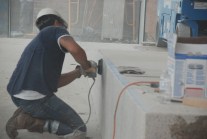 Many of the issues that cause customers and architects to stop using resinous flooring products are not due to the products themselves; the lack of proper preparation causes as many, if not more failures than hydro-static pressure or bad materials. While the construction market is price driven, it is always important to use contractors that have a reputation for success and service. While it is not always possible to have a perfect installation every time, choosing the correct professional to work with will give you a successful final product. The goal is to get it right the first time, but what separates good from great, is how a contractor deals with adversity.WHY IS PREPARATION SO IMPORTANT?Unlike many other flooring products, finished Resinous products are technically manufactured in place. Ceramic Tile, VCT, and many other sheet flooring goods are manufactured in a controlled environment and installed at your job site; Resinous materials are shipped in parts and manufactured onsite. While this makes installations more challenging, it gives the customer and installer much more freedom for completing necessary details on site without creating seams and awkward transitions. The most important part of the installation process for Resinous Flooring, is the floor preparation. The longevity and overall performance of a Resinous Floor depends on its mechanical and Chemical bond to the sub floor, and this bond can only take place within the porosity of the sub-floor.”Mechanical bonding is a kind of chemical bond that is usually found in rotaxanes and catenanes or other molecular structures that are mechanically interlocked. In this type of adhesive bonding, the adhesive material locks physically onto the surface crevices.” Mechanical/Chemical BondsSimply put, by increasing the profile of a surface and in conjunction with the molecular bonds withing the resin, a chemical and mechanical bond results, creating a bond that is much stronger than the internal bond of the substrate. If a Resinous Floor is installed properly, the internal bond of the substrate should fail before the Resin bond to the substrate. This can be measured quantitatively with a elcometer pull test. ElcometerThere are multiple ways to prepare a substrate for a Resinous floor, but most manufacturers follow standard requirements based on the Resin materials viscosity and specific unique qualities. “A concrete surface profile, known as a CSP, is a standardized measurement for the ‘roughness’ of a surface that is defined by the International Concrete Repair Institute (ICRI). A very rough surface will have a high CSP number, such as CSP 9. A very smooth surface with almost no preparation at all will be a CSP 1.” CSP Reference The ICRI (International Concrete Repair Institute) CSP Chips developed the CSP standard and provides sample chips for evaluating the profile on concrete surfaces. Depending on the thickness of the Resinous system, a CSP profile can be achieved chemically or mechanically by many techniques. In past decades, acids were used to profile the concrete, however due to the difficulty in neutralizing acids and the environmental impact, this practice is rarely done. While every different type of Resinous material has its strengths and weaknesses, their overall performance relies on the bond of the system to the substrate. If proper steps are not taken, a suitable material will fail at the bond line. Without going into great detail, below is a short guide to Resinous floor preparation based on some commonly used system types.Urethane Cements: Most of these types of material are at least 1/8″ thick and many are installed as a mortar exceeding 3/8″. While a CSP 3 is acceptable for most manufactures, a much higher CSP is commonly used (3-5). Along with utilizing shot blasting Blastrac Link or scarifying; key ways must be cut around transitions, terminations, drains and any other breaks in the floor due to material shrinkage during the curing process – not only at the termination but 6″-12″ from the termination.Other Resinous Mortars: Most other mortars are epoxy, but some other systems could include MMA or other resins; Like the Urethane cements, a heavy CSP will add to the quality of the bond, but most other mortars will not need Key lines except at transitions to other materials like metals.Self Leveling Resins (including Flake and Quartz Broadcasts): Many systems that fall into this category are decorative. A CSP 3 is good for SL’s, but any higher CSP can lead to preparation lines telegraphing through the surface. All transitions should always be keyed for any resinous system for strength.Thin Mil Coatings: Most thin mil coatings can be prepared by diamond grinding or “brush blasting” with a shot blaster. A CSP 1-3 is suitable depending on the thickness and manufacture of the materials.NOTE: This is just a simplified guide to preparation, and an installer should always follow the material manufactures recommendations for any system. It is important for the end user and designer to understand the importance of preparation. For a manufactures example please see: Concrete Preparation Guide from Sherwin Williams Summing it up: Because I don’t believe in long reads, I’m going to touch on some other important topics in closing that I will cover in more detail at a later time. None of the above information accounts for slab conditions or other materials that may have been installed previously on the substrate. Preparation is tedious and important to comprehensively understand before installing Resinous products, but if it is done correctly, those products can outlast anything on the market.please feel free to ask questions and leave comments about any other topics that you want covered.
Lets Talk Floor Prep


 Resin Adviser