
Lessons Learned

Do not get so caught up in the promise of success that you neglect the details.  As a blanket statement, that is good advice; as a directive for prospecting and bidding projects, it is a necessity.

While the largest profits come from taking chances, those chances can lead to the largest losses.  When a large opportunity knocks on your door, there is a temptation to throw everything into chasing it.  It is like buying a lottery ticket and planning on how to spend the money before the numbers are even drawn.  Many times, the projects that support you get neglected and overlooked while the possibility of a “better” project takes up important assets.  Take caution in the pursuit of large high profile jobs, everybody is chasing them, so they typically get awarded under value, putting pressure on production before the project every begins.  Never neglect the base business that supports your overhead.  While perusing jobs that stretch you is important, keeping up with what has sustained you is more important.

It is easy to forget that the tortoise wins the race when the possibility of a jet pack is put in your path.  Never forget what kind of projects got you were you are today; it is good to stretch, but even the best rubber band will break if it is stretched to far.  When an opportunity is placed in your path that has the potential of catapulting you to the next level, be very cautious.  Do not turn and run, but investigate all avenues of success and failure and do an extra amount of due diligence before you proceed.  The biding process is the foundation for the project and has the power to define the future of a job.  Calculate the costs of any possible failures and make sure the remediation is included into the project cost.  Figure the time and assume that things will not go according to plan.  While this is true almost ever time in construction, other business types have similar delays.  Account for any equipment that will be needed, or might break.  Add extra travel expenses, including supervision.  When all of the tangibles and intangibles are figured, do not cut your profit to get the job.   This initial step is very important, but if you receive the project, do not go into auto pilot, your work is just beginning.

High profile unique projects that, on the surface, appear to be an opportunity to elevate your influence to the next level in your industry should be approached very cautiously.  Projects of this caliber cannot be confronted in the same way as other projects.  One truth in every industry is that every job is unique and has its own set of problems.  The larger the scale, the more there is to loose or gain; make the best of the situation and plan for the unexpected.  Along with job specific challenges, financial challenges can make large projects particularity problematic.  Before a contract is executed, perform a detailed financial review covering the time period of the projected project.  Confirm that cash flow from other projects will support long payment terms and tying manpower up for long periods of time.  If payments get delayed, there will be need to be income from other sources to support overhead expenses.

Trust and professional respect are important on any project, but enter into large projects with partners that have a history of fairness and flexibility.  There will be issues that come up where a working relationship can save costly mistakes.  Communication is key, especially when there are financial implications.  Partner with trusted suppliers and make them aware of the scope of the project prior to entering into a contract.  It is important to know that the supply chain will be in place to support the base work and any changes that might creep up during production.  Clarify billing and payment terms with the customer and supplier so that everyone is aware of the payment cycle.  The best relationships can be challenged when payment terms are not met, creating critical problems with any project.

“Success is not final; failure is not fatal: it is the courage to continue that counts.” – Winston Churchill

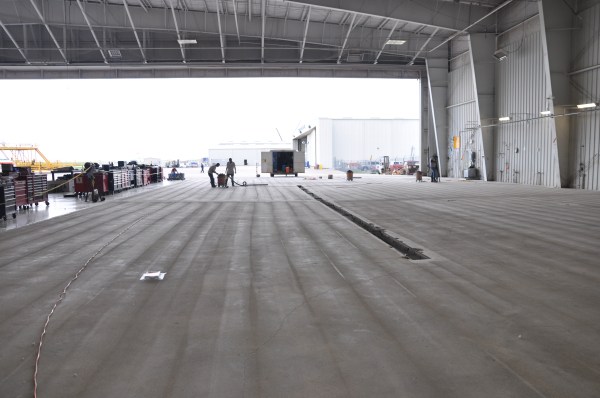
All of these tips come from experience, both success and failure.  The best planed project in recent memory, was a meat packing plant on a prison unit.  80,000 sq. ft. of flooring, including some mortar walls and cove base was completed in a decades old facility during a 42 day shutdown.  Detailed planning went into the products, lodging, crew rotations and security.  The project beat its deadline and ended in success.  The process was difficult, took daily management, and did not complete without its set of problems, however in the end, it was completed ahead of schedule and under budget.  On the other hand, a biomedical project that had a very unique scope and size took 4 times longer than planned.  Some very difficult scope issues were not resolved correctly and early communication issues plagued the project leading to a sizable loss.  It is important to realize that projects have variables outside of your control; use your past experience and knowledge to get ahead of problems before they become costly losses.

Experience is a painful teacher that can build wisdom; if problems are not addressed quickly, all of the lessons can cost profits or worse if left unaddressed.  Use these examples to build a better tomorrow by picking projects that are within your capabilities.  Partner with customers and suppliers that can offer support and communication.  The most difficult thing is seeing years of work disappearing into one project.  The right project can define you; the wrong project can destroy you.  Be smart, pace yourself and stretch yourself – but not to the breaking point.

“There are no secrets to success. It is the result of preparation, hard work, and learning from failure.”– Colin Powell

Resin Adviser

 

LEARN from your Failures

If you have been in business for more than a few years, and have run into a problem job, I am speaking to you.  If you have not had the misfortune of getting stuck with a contract that is impossible to profit from, then you need to keep reading; the process of biding jobs correctly has the power to save your bottom line.  The most important thing about a bad job, is learning how to avoid the same pitfall again…and again.  For many years, a business can coast along with some small failures and successes; coasting leads to complacency and a false sense of security.  Taking your eye off of the planning process and letting inertia run your business, is a recipe for dangerous problems, and can lead to projects that have the potential to stop growth in their tracks.

plan

The first step in dealing with a catastrophic contract (project), is surviving it; regroup and make a plan to focus on completing the tasks directly in the path of future survival.  The second step is moving back so that the problem does not block the road to future success.  The two most costly mistakes in dealing with difficult jobs are ignoring them and/or letting them consume you and allowing them to block future progress.  Without the ability to continue profitable operations, a blind focus on the problem can cut off any other profitable operations, leading to reduced cash flow.  The most important thing is to find a way to solve the issues you are faced with, without cutting off continuing work.  This process can be especially challenging when the solution takes up valuable time and manpower that is needed for profitable projects.  Balance is the key to future recovery.  In some situations, downsizing or cutting back might be necessary; be cautious and review your overhead, making sure that the cost of the solution can be covered by other ongoing projects.

USE FAILURE TO BUILD A FOUNDATION FOR FUTURE SUCCESS.

In the beginning, do not analyze the problem, only the solution, while you are in the middle of solving a difficult situation.  When the problem is past, there will be time to figure out what went wrong so that meaningful changes can be put in place to avoid future issues.  Use the moment to work through a solution that will not only make your customer satisfied, but will leave you operational and functional at the other end of the solution.  Many of the best repeat customers come from handling bad projects in a responsible professional way.  Easy jobs rarely lead to new knowledge; difficult projects always lead to a better process that can be used as building blocks for future projects, processes, and success.  Turn the wall in front of you into a gate; let the process teach you how to succeed in the future, and what solutions work best.

Gate

Never give up on your future and always keep in mind that there is opportunity on the other side of the wall (problem).  Look for the gate/opening and work hard to get through it; on the other side is a better future.

Experience is the best teacher, and ignoring past mistakes can extinguish future goals and success.  After completing a troubled project, take some time to analyze the the steps that led to the problem, and the measures taken to correct it.  Take some detailed time with all of your team members to discuss avoiding the same issues and come up with solutions that can be turned into profit on future projects.

  • Take a detailed look at the project from the bidding stage forward.
  • Identify the problem or problems
  • Review the steps taken to resolve the issue
  • Make a detailed list of solutions
    • Decide if Similar projects will be eliminated from your bid list
    • Alter your process of estimating similar projects
    • Fine tune your solutions – make recovery easier on future problems
    • Do not file your solutions away – make meaningful changes immediately
  • Inform your WHOLE team of the problems and solutions – keep a visual reminder of the project so that it will motivate your team to stay aware of avoiding costly mistakes.

Team members need to feel confident that leadership has identified what lead to project problems, and has resolved the issues; they also need to be a part of identifying future hurdles.  It is important for every member of the team to keep a lookout for anything that could trip up success.  Many times, management cannot see the issues early enough to make appropriate changes; by keeping everyone on watch, many small issues that can lead to major problems, can be avoided.

Stay positive, executive confidence can make or break a problem when your whole team is in the trenches fighting for a resolution.  Keep on task and do not let your team give up on future projects; those projects will be the catalyst for future success.  When the walls are closing in, never forget that there is a solution to every problem.  As a leader, it is your responsibly to guide them down the path to a better place.  If you can keep your team on task without loosing faith in the future, then the very worst situation can lead to a stronger future.

Make meaningful changes, and make them visible.  It is important to let your team and your customers know that, by identifying the problem, change can make your company better.  Let your team be part of the solution and take ownership in real change; listening to suggestions, and using them for the final solution will build a stronger bond with your team.  When leadership lets the whole team be part of the solution, real change has a better chance of success.  Keep sight of past success and do not change the things that makes your company a unique commodity; the goal is to make things better, not to reinvent yourself.  If you want real long term success, it is important for your company to have an identity; do not let corrections change the things that your customers like best about you.

Don’t let Problems Define you, let them shape your future; If you are already successful, you can use them to make you stronger.  If you are just starting out, you can learn from the experience.  Never let them discourage you from your dreams.


A Family Affair -The Challenge of Conducting a Family Business.

A Family Affair:

The operational challenges facing every type of family business can be rewarding and crippling at the same time; facing the normal demands of running a business with the added dynamic of family pressures often tests the best entrepreneur to the limit.  This complication often makes for extra stresses that can either sink a successful venture or bond it together and make it invincible.  While the challenges far outweigh the normal stresses of work, having multiple members of a team that treat a business as their own can lead to unequaled dedication and work ethic.

The Bad:

Most family businesses pass from generation to generation, however there are many different forms of family operations that do not follow the usual model.  Some companies are started by the younger generation and joined later by the older generation or siblings and other family members.  While there are challenges facing every type of family business, the chain of command that evolves when roles are reversed can add to the already stressed environment.   Navigating role reversals in a business environment can be like navigating the Titanic around ice burgs; the roles must be constantly confirmed and adjusted to find a successful path that is both effective and acceptable for every individual involved.  Failing to define roles can lead to conflicting decisions that cause confusion for both employees and customers.  The solution, painfully difficult, is to have the roles clearly defined in the Articles of Incorporation and make sure that the roles correspond with company ownership and abilities.  While this is one of the more difficult things to do on a personal level, it will save years of pole positioning that will undoubtedly cost time and personal relationships that cannot be recouped.

Financing a family business can be an extra added challenge that has the ability to test the patience of the most stable families.  While setting out to open a new venture, guidelines must be set, there are countless numbers of situations that can require additional funding that all of the parties involved my not have access to.  The handling of financial situations must be clear cut, and set forth prior to any additional funding, and a payment schedule must be agreed upon with documented guarantees to make sure that all of the parties involved understand the intent and payback plan.  No mater the relationship, finances have the ability to drive a wedge in operations when the lines get blurred between business and personal relationships.

Fam Bus2

The Good:

A family operation can be stronger than any individual company for many reasons; experience, teamwork, and diversity can make a companies leadership more successful to a larger customer base.  For many family operated companies, past generations have contacts and experience that the whole company can benefit from; utilizing skill-sets and contacts can lead to rapid growth of a new company.    If the older generation desires a less rigorous schedule and lower stress, then having multiple generations involved can join experience and energy into a cohesive momentum that can boost overall confidence and momentum for both the employees and customers alike, letting all of the partners participate at their desired rate.

Pooling expertise and money can lead to a more rapid growth and overall success rate that far surpasses the abilities of a single owner start up.  The key is to avoid the financial and emotional hurdles and race towards the end goal together with a clear plan and teamwork.  While this kind of operation is not for everyone, when it is successful, it can lead to a healthy work and personal life.  Another key benefit to family operations is a clear line of succession that adds stability for both employees and customers, allowing a business to obtain better hires and larger contracts.

The combination of instant business with injected energy is a recipe for success as long as the internal communications withing the business is done well and often.  Communication is the single largest key to the internal success of a family business, with the power to propel success or take a company down quickly.  Below are a list of questions that can either guide you to make the jump into a family business, or help get one back on track.  In my experience, everything is playable but must have a stable foundation; a team must be wiling to make changes that lead to success quickly, but must stick to the foundation set at the conception of the partnership.

Questions:

  • Have you ever been in business with a family member before, or do you know anybody that has?  Get some advice from someone with experience.
  • Do you have the financial means to operate a business if one or more of your family members (partners) want out?  would they be willing to help even if they were not involved?
  • Are you prepared to give personal guarantees (financial) to your family members (partners)?
  • Are your family members (partners )financially stable; are you?  Will you have to front most of the capital?
  • Are you willing to put in sweat equity to off set any other members financial contribution?
  • Do you operate well in a team setting, or are you more of a lone wolf?  This can be structured into a business with multiple people as long as all parties are aware of the “decision making process”.
  • do you and/or your partners have experience in your industry? Is the experience equal?
  • Is this venture being considered due to current financial/personal strain? check your motives.
  • are you and your family members (partners) willing to put in the long hours required to successfully run a start up?
  • Are you willing to fail? Is there a backup plan?

Hopefully this short article will help with providing some important questions and lessons gained from experience.  Please feel free to add any input or questions in the comment section, and go out there and be successful at what you do.  Plan hard, work harder, and have fun along the way.  A well structured family business can be very satisfying and allow for flexibility unequaled in any other business type.

success


Planning The Perfect Project – A Work in Progress

“A goal without a plan is just a wish.” ― Antoine de Saint-Exupéry, writer and pioneering aviator

If you are like the majority of business owners and project managers working in construction, you might put projects together conceptually on bid day, but not take the detailed effort to plan them after contracts are received.  Planning can easily be the largest post bid factor to higher profits in the lifespan of a project.  For most estimators, the bid process is a scientific process of multiple hypothesis based on a set of lines and specifications mixed with past experiences.  In the wold of estimating, everything is in theory and based on past projects, but nothing is “concrete”.   In most cases, a project starts as an invitation and then moves to drawn details and plans that amount to lines on paper or a computer screen.  Taking plans and putting them into reality is a delicate process of infinite variables that nobody has complete control of; this fact is what leads many good leaders to abandon detailed plans and rely on instinct and quick reactions to drive a project.  This very same instinct can lead down a trail of costly mistakes and avoidable rework if it is not executed correctly.

While bidding is taking your best guess based on past experience, and putting a realistic number to a plan, project planning is much more involved.  This process is commonly overlooked because the daily inertia of other ongoing projects keeps focus on the NOW and not the FUTURE.  One of the most difficult transitions for a contractor is moving from bid to reality; it is hard to take the plans from an estimators desk (and mind) and transport them into the actions of field installers.  Even when managers stay on task and work with installers on a daily basis, projects can still suffer from poor plan execution if the plan is not put into place before the project begins.

A Good Resource for Project Planning

Sometimes preaching to the choir is my calling; As a manager and owner, I have suffered the shortcomings of poor planing, more times than not.  It takes one well planned and executed project to highlight all of the shortcomings that exist in other projects, and one very poorly planed project to send the team racing back to the dry erase board to fix upcoming projects.  Through my experience, below is a few steps that can guide a team through the process; it is a simple guide that needs to be fine tuned per project and scope, but can serve as a starting point for a successful project.

  • 1.  Start with the Bid Process but do not waste valuable time:
    • Look at every relevant specification and detail to your scope of work (don’t assume you know what the customer wants)
    • Start early enough to ask questions – Make sure you get the answers.
    • If in doubt – clarify your scope on your estimate.
    • Pull from past experience and make adjustments (know your limitations and price them into the project – whatever can go wrong, probably will times 2)
  • 2.  Save your work and notes (not documenting today will leave you scrambling tomorrow)
    • Keep all handwritten notes and scan them to a data file.
    • Keep any photographs of the site in a data file.
    • Keep any important detailed drawings/plans and save them to a data file.
  • 3.  Look over the Contract (if you are lucky enough to be the winning bidder)
    • Is there a reason you were the low bidder?  Qualify your bid before executing contracts)
    • Check you raw material prices – suppliers may have raised prices after you bid the project.
    • Check your work – make sure your bid was based on the most recent plans and addendum’s.   Don’t get caught giving free work for something you can clarify before entering into a contract.
    • Deal with reputable Contractors – let experience guide you into contracts with people that you can trust.
  • 4.  Schedule:
    • Place the project on a schedule as soon as you can (it can be moved)
    • Be flexible but firm – Schedule 25% extra time for a job and make sure you have the manpower to accomplish the published schedule.  Under promise on your schedule and Over deliver.
  • 5.  PLAN:
    • Meet with your teem at the time of contracting and set up a time to go over details before project begins.
    • Don’t waste time – Planning to early is nearly as bad as not planning if either the wrong people are in the meeting, or to much time goes by before the project – “timing is everything”.
    • Set out some goals for ordering materials, special tools and select preferred applicators for a project.
    • Have everything you need available before a project begins (keep in mind that you will never really have EVERYTHING)
    • Agree with your team, that the plan is a living thing – be open to its evolution.
  • 6.  Execution:
    • Always schedule a pre-construction meeting or site visit at least week before begging a project.
    • Share your plan with the project superintendent and project manager before beginning – put in in writing.
    • Start by assuming that the plan is a good one and get to work
    • Be prepared to modify your plan – the better the plan the less you will have to change; changes to your plan, if done correctly, should result in a change order.
  • 7.  Finish Strong:
    • Pre-punch all of your work and have any site supervisor inspect it before you leave – re-mobilizing is costly.
    • Many projects hold retainage until projects reach substantial completion; secure your final payment by getting any punch list items signed off on.
    • Do your paperwork – Bill the project and turn in all paperwork so that there are no hurdles holding up your final payment.

While the seven items above all appear to be common sense, my team misses many of them on every project due to project blur (the process of overlapping projects that keep a person from giving 100% attention to one thing at a time).  It is important to let a team process one project at a time, and move onto the next project once finished.  In our industry, it is nearly impossible to dedicate time to one project at a time; a team must set limits on meetings and close out one subject before beginning the next.  Try to plan ahead so that when a project is in front of you, there are no time consuming details keeping you from focusing your attention on the next bid.  Like almost everything in life, the process is cyclical and must be kept up with at all times; looking back just slows you down.

“Every minute you spend in planning saves 10 minutes in execution; this gives you a 1,000 percent return on energy!” ― Brian Tracy, author and motivational speaker

Planning2

What a Difference the Topcoat Makes.

It is hard to figure out exactly what is the best product to use for each project when there are so many options available.  While the finished products may look similar and the aggregates used can make the initial colors and textures identical; the materials used in the system are very different.  For a designer or architect, it is important to choose the best product for the customers use and the environment.  When resinous flooring first came to the United States, there were few choices, but today there are many choices to provide the best produce for each and every project.  I will try to simplify the process and help clarify the selection process.

First, it is important to understand the major material options.  There are four major options for use in most projects, and they are available from most of the more mainstream manufacturers.  Epoxy, Polyurethane, Polyaspartic, and MMA are all used as topcoats and  complete systems in many resinous flooring projects.  All of these products are transparent resins that are made up of multiple components and cure to a clear finish.  All of these products except for MMA will look very similar directly after installation unless additives are added for texture.  The danger of not understanding these products is that most people cannot tell the difference between them until the floors go into service, and by then, it is too late.

web banner formulation guidelines scientist lab

Chemists have spent years developing resins that will work well in different environments.  While epoxies of the last century worked well, there were weaknesses that needed to be resolved.  Below, I will try to outline the best qualities of each type of material.  It is important to understand that the application of each product has an impact on the finished product and some of the products listed are more difficult to install than others.

Epoxy is the grandfather of the others in the resinous flooring industry.  It is strong, easy to use and still very relevant.  Epoxy has been used for flooring for many years and is still used on many projects.  While many systems are entirely made up of Epoxy, they are also used as primers and base coats for other types of systems.  Epoxy’s bond well to concrete and to themselves; they work well with sand and aggregates and rarely cause problems with out-gassing or fish-eyes.  Think of Epoxy as a great building block or foundation to many other flooring systems.  While epoxy has great qualities, it also has weaknesses.  Epoxy turns amber over time, and even though scientists have improved its light stability, it is still not as light stable as its newer cousins.   Epoxy is also not very resistant to heat; it is however chemical resistant, especially in its Novalac form, but much less light stable.

PolyUrethane is the next step up in Resins; it is very clear and light stable.  Urethane’s first gained popularity in the flooring industry as topcoats on epoxy systems in airplane hangers and automobile dealerships.  First generations urethane’s contained solvents and would not meet today’s VOC requirements, but there are many low and no VOC options available today.  While urethane’s solve many problems that plagued epoxies, they still do not bond well to concrete or each other.   Urethane’s are very chemical resistant and more tolerant to higher temperatures, but do not work well as a stand alone system.  Urethane’s are best used as topcoats over epoxy systems where high traffic, light stability, gloss, and temperature are issues.

Polyaspartic is similar to urethane, but much faster.  Many Polyaspartic products have little to no odor and cure very quickly.  While the rapid cure can be a positive, it can also be an extra challenge to installers who are not familiar with working quickly.  These products, like polyurethanes, do not bond as well as epoxy to concrete and do not bond well to each other without extensive preparation.  Polyaspartic systems can work well, but must be installed quickly and within redcoat windows to make sure each coat bonds to the other.  These products are very light stable and remain clear compared to their epoxy counterparts.

MMA cannot be ignored as a relevant option in the resinous flooring industry.  This product is probably the best resinous product for exterior work.  MMA bonds well to itself and is very light stable.  Unlike its cousins, it is not glossy.  MMA products cure quicker than any of the other resins and can be a challenge for installers.  These resins can be very tricky to work with and have a strong odor that cannot be used in many occupied facilities.  While MMA’s are popular due to their speed and chemical resistance, the hurdles in their installation limits the availability of quality installers.  MMA cannot be used as a topcoat on another system unless it proceeds a total broadcast or completely cured product; it can literally melt other resins.

When you have a project, it is best to consult with a professional to come up with the best system that will work for your environment.  The first step is having an understanding about the products, and realize that they all have their strengths and weaknesses.  Finding the right combination, can lead to a successful project.  For the best results, it is important to have the best product specified so that the installers (bidders) are clear about the expectations and use a product that will give the customer the best finished product for their environment.

Lets Talk Floor Prep

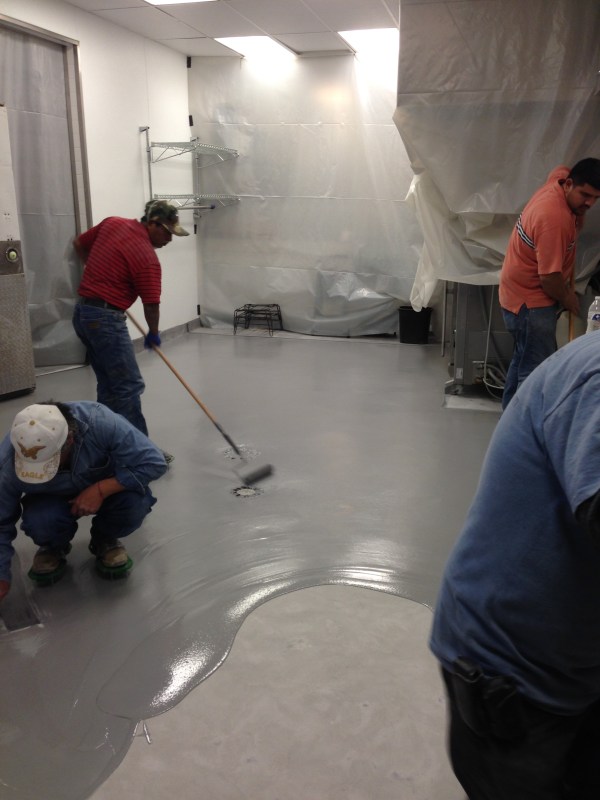
Many of the floors being installed today fail due to improper preparation; in an ever growing competitive environment, contractors are pressured to cut costs to meet project budgets.  With the requirement of using specified materials, there is very little that can be done to lower costs in competitive bid situations; most Resinous flooring projects are at least 40% materials.  With labor costs on the rise, the difference between winning and losing a bid, is lowering the overall labor costs.  Much of the cost of labor is tied up in preparing a floor for installation, therefore that is where many contractors make up time to make their bids more competitive.  Owners, General Contractors and Architects need to be aware of this practice before selecting a contractor for a Resinous Flooring project; even though a very low bid is tempting, every bid needs to be qualified.DSC_9538Many of the issues that cause customers and architects to stop using resinous flooring products are not due to the products themselves; the lack of proper preparation causes as many, if not more failures than hydro-static pressure or bad materials.  While the construction market is price driven, it is always important to use contractors that have a reputation for success and  service.  While it is not always possible to have a perfect installation every time, choosing the correct professional to work with will give you a successful final product.  The goal is to get it right the first time, but what separates good from great, is how a contractor deals with adversity.WHY IS PREPARATION SO IMPORTANT?Unlike many other flooring products, finished Resinous products are technically manufactured in place.  Ceramic Tile, VCT, and many other sheet flooring goods are manufactured in a controlled environment and installed at your job site; Resinous materials are shipped in parts and manufactured onsite.  While this makes installations more challenging, it gives the customer and installer much more freedom for completing necessary details on site without creating seams and awkward transitions.  The most important part of the installation process for Resinous Flooring, is the floor preparation.  The longevity and overall performance of a Resinous Floor depends on its mechanical and Chemical bond to the sub floor, and this bond can only take place within the porosity of the sub-floor.”Mechanical bonding is a kind of chemical bond that is usually found in rotaxanes and catenanes or other molecular structures that are mechanically interlocked. In this type of adhesive bonding, the adhesive material locks physically onto the surface crevices.” Mechanical/Chemical BondsSimply put, by increasing the profile of a surface and in conjunction with the molecular bonds withing the resin, a chemical and mechanical bond results, creating a bond that is much stronger than the internal bond of the substrate.  If a Resinous Floor is installed properly, the internal bond of the substrate should fail before the Resin bond to the substrate.  This can be measured quantitatively with a elcometer pull test.  ElcometerThere are multiple ways to prepare a substrate for a Resinous floor, but most manufacturers follow standard requirements based on the Resin materials viscosity and specific unique qualities.  “A concrete surface profile, known as a CSP, is a standardized measurement for the ‘roughness’ of a surface that is defined by the International Concrete Repair Institute (ICRI). A very rough surface will have a high CSP number, such as CSP 9. A very smooth surface with almost no preparation at all will be a CSP 1.” CSP Reference  The ICRI (International Concrete Repair Institute)  CSP Chips  developed the CSP standard and provides sample chips for evaluating the profile on concrete surfaces.  Depending on the thickness of the Resinous system, a CSP profile can be achieved chemically or mechanically by many techniques.  In past decades, acids were used to profile the concrete, however due to the difficulty in neutralizing acids and the environmental impact, this practice is rarely done. While every different type of Resinous material has its strengths and weaknesses, their overall performance relies on the bond of the system to the substrate.  If proper steps are not taken, a suitable material will fail at the bond line.  Without going into great detail, below is a short guide to Resinous floor preparation based on some commonly used system types.Urethane Cements:  Most of these types of material are at least 1/8″ thick and many are installed as a mortar exceeding 3/8″.  While a CSP 3 is acceptable for most manufactures, a much higher CSP is commonly used (3-5).  Along with utilizing shot blasting Blastrac Link or scarifying; key ways must be cut around transitions, terminations, drains and any other breaks in the floor due to material shrinkage during the curing process – not only at the termination but 6″-12″ from the termination.Other Resinous Mortars:  Most other mortars are epoxy, but some other systems could include MMA or other resins;  Like the Urethane cements, a heavy CSP will add to the quality of the bond, but most other mortars will not need Key lines except at transitions to other materials like metals.Self Leveling Resins (including Flake and Quartz Broadcasts):  Many systems that fall into this category are decorative.  A CSP 3 is good for SL’s, but any higher CSP can lead to preparation lines telegraphing through the surface.   All transitions should always be keyed for any resinous system for strength.Thin Mil Coatings: Most thin mil coatings can be prepared by diamond grinding or “brush blasting” with a shot blaster.  A CSP 1-3 is suitable depending on the thickness and manufacture of the materials.NOTE:  This is just a simplified guide to preparation, and an installer should always follow the material manufactures recommendations for any system.  It is important for the end user and designer to understand the importance of preparation.  For a manufactures example please see:  Concrete Preparation Guide from Sherwin Williams Summing it up:  Because I don’t believe in long reads, I’m going to touch on some other important topics in closing that I will cover in more detail at a later time.  None of the above information accounts for slab conditions or other materials that may have been installed previously on the substrate.  Preparation is tedious and important to comprehensively understand before installing Resinous products, but if it is done correctly, those products can outlast anything on the market.please feel free to ask questions and leave comments about any other topics that you want covered.
Inspired Vision

The road to a successful job is not always clear and easy to navigate, even when detailed planning and preparations have been made.  Each project is a new detailed challenge that can be looked at as an obstacle or a learning experience; perspective is everything. Most of us are caught up in the inertia of life, and don’t want to take the time to create a vision that will move team forward.  The priority should aim for new way of looking at problems that is constructive and motivating.  It is easy to get stuck in the rut of work or a project and lose sight of the original intent or vision; this lack of proper perspective can lead to decisions that are often off target and costly, especially when you are suffering from job fatigue.

The examples here are related to the construction industry, but are somewhat universal in their application.  Before a project begins, it must be conceptualized before it is sent out to bid.  The bidding process is one of the most exciting phases of a project because it is the phase that holds the most hope.  Hope is one of the great motivators that keep energy alive and pushes progress forward.  This phase is especially important, because it is the foundation of a successful vision.  After the bid process, is a sometimes long and drawn out phase of waiting so see if your bid was accepted; this phase can be discouraging and monotonous.  Once a project is contracted then the excitement builds again as the planning phase begins; this phase can make or break a project, however to much focus on planning and not enough on inspiring a vision can lead to project fatigue and loss of profits.

How do you inspire a vision and hold on to it for the duration of a project? 

Like falling in love for the first time, getting an inspiring vision is not to difficult; the difficult part is finding a way to hold onto that vision and see a plan through to the end of a project.  “keep it simple stupid” is a good way to look at plan, even if it is a large and complicated project.  The best plans are easy to remember and execute by all members of your team.  Like the carrot and stick, there needs to be a goal to chase that is simple, comprehensible, and measurable.  If the team buys into a project early with goals that are simple and real, then a plan can be made for success The plan needs to be more like an outline than a doctoral dissertation; overwhelming details can get overly complicated and forgettable.

Many years ago, I started thinking differently about preparing for a job and inspiring a vision for success.  There is no way you can plan on every variable that may occur on a project, so over planning is a wast of time and energy; it has the ability to overwhelm and uninspire your team.  It is always better to be prepared for action by having the willingness and tools to respond quickly to changes.  Making contingency plans for every scenario that comes to mind wastes time on scenarios that probably will not ever happen.  If you plan on specific worst case scenarios, the one that you did not think of will take you down; if you are prepared to react to any and all changes by being mentally prepared, then your team will have the tools available to react to any problems that arise.  It may sound like a subtle difference, but in the planning process it can save valuable time and impart confidence to your team.  Let them know that they can handle anything put before them and that there will be challenges, but with your help and their willingness to work through them, success can always be found in adversity.

The success of a project starts with a solid foundation (the bid), a competent plan (the vision), and a leader (inspiration) to carry the plan out with out causing job fatigue.  Sometimes the greatest knowledge can be simple and straight forward, but the hardest part is being the leader who can inspire.  First, think about what you want to inspire, and then think about how to go about it; a leader should always be able to disarm any situation and bring balance back during chaos.  This is a skill that can be learned but usually is developed over years of practice….and failure.  When a leader is willing to take the responsibility of the team on and carry the weight of a project no matter the outcome, then inspiration will follow.

Most people are shut down by the weight of responsibility when things don’t go as planned and when blame is quickly assigned.  Teams become individuals when the responsibility is directed at one person.  Team members don’t take important risks when they are criticized for making decisions; this kind of environment does not lead to visionary thinking and will cause a job to suffer because it discourages thinking out side the box.  Creative thinking and pushing through adversity, rather than looking for blame will keep the vision alive; there will be time to evaluate decisions and mistakes when the project is finished.  While it is important to identify and isolate mistakes for future visions, it can be a momentum killer during the progress of a project.  Only major team failures need to be addressed and removed during the middle of a project; it is always better to do what it takes to keep your team moving forward towards their goal.

To be a leader in any team, especially in construction you have to learn to fine tune walking the line between firm, calm and aggressive.  It is important to fight for your team while still remaining calm under pressure.  If you have laid the proper foundation and cast an inspiring vision, then you can lead your team to a successful project even when things get tough.


There is no Secret to Success

RR

Success is a combination of many factors that have to fall into place in perfect timing for them to work at their maximum potential; we were all created to succede if we pursue our given paths.  Several key factors are, your starting point, your personality, your education, your work ethic, your “demographic”, and your location.  If you get the perfect combination of factors then you will find some degree of success, but it is not all up to chance.  The degree of success you achieve will depend on how the factors line up and how hard you are willing to work on lining them up.

These factors can be grouped into two main categories; static, and dynamic.  Static factors cannot be changed but can be overcome and they set the foundation for building on the dynamic factors.  Static factors include your starting point and your demographic; they can also include other physical or social factors that play into success.  Dynamic factors are the building blocks that form success after the foundation is set; they can make or break any idea no matter ho perfect it may be.  No matter where a person starts with their static factors, they have the ability and calling to succeed.

STATIC FACTORS: 

Many people across the globe find that the most difficult hurdle to jump is the first one; the one that you find in front of you before you begin a single task.  We live in a time of political correctness and race equality, however there is still prejudice in every around every corner  The color of your skin or your sex is not the only factor that may have an impact on your future success.  Studies suggest that tall people are more successful than their shorter counterparts; if you are missing a limb or a digit, that could be a factor that changes your starting point.  Unfortunately the world does not judge us equally and we have to overcome our social status by working through the factors that we can change; our dynamic factors.

Demographic means: “a specific segment of a population having shared characteristics” (demographic )  Most of us were not born wealthy or into a family that was part of the most accepted religion, race or economic status, but we were raised in a place where we where accepted.  Even though a person might be accepted in their micro environment, they might not be acceptable to the business community.   There was a time that being born female meant that your path was already carved out for you; there were social expectations that limited the path to success.  The color of your skin might help you in one community or career path, but my hinder you in another.  Your Static position is the type of variable that can be best utilized by focusing on acceptability and balancing the amount of effort needed to elevate dynamic factors in your life to achieve you success goals.  

Sometimes your path is defined by physical differences, injuries or imperfections.  Each society has a picture of success and those following that patth find much less resistance if they match the social image expectation.   (http://www.businessinsider.com/tall-people-are-richer-and-successful-2015-9 )  I am sad to say (because I am  a 5′ 7″ male) that tall people are more successful than short people, and this is not the only trait that predicts your static foundation to success.  Many people have missing limbs or deformities that make it very hard to get the right kind of attention.  Even though we all start at a different place, there is still very good news for everyone; you can overcome your static dispensation, and you do not have to abandon it.

DYNAMIC FACTORS: (The great equalizer)

HOPE

There is hope regardless of your starting place; the great equalizing factors are the dynamic factors and how willing you are to utilize the part of the equation that you have control over.

“The three great essentials to achieve anything worthwhile are, first, hard work; second, stick-to-itiveness; third, common sense.”
– Thomas A. Edison

Your personality, your education, and your work ethic may have the greatest impact on your path to success.  Your personality can be broken down into many facets starting with first impressions.  You must perspire confidence and cloak it in humility.  This is a natural thing  but can be learned; most commonly it comes with your upbringing.  Many people can be off putting if they are overly eager or if they hide in the corner away from attention.  Finding the perfect balance of communicating and leaving a lasting impression that gives just enough intrigue to hold a place in a persons mind without overwhelming them is an art and talent.  If you are not engaging, be knowledgeable and humble; if the personalty sparks don’t fly, just be the wisest person in the room, even if that means being quiet.

Along with your first impression, you need to have common sense.  While education can open doors and give you knowledge, you need to posses the special gift of problem solving.  Some people are given the gift of knowledge but cannot solve a common problem; other people find themselves mediocre in education but can solve complicated real word problems through experience.   The key is knowing who you are and focusing on your strengths.  Many entrepreneurs are problem solvers who hire intelligent people to work out the details; they could never succeed in a field that requires higher knowledge and focus.  Set your strategy of success on the right path based on your personality and back that up with the right kind of education and experience.

Education has many purposes and can serve to prepare you for your career or catapult you into fellowship with the peers that will help open the doors to your future.  Many paths to success require specific knowledge that a person can only get through higher education; those people who are inclined to lust after that knowledge should take the path to higher learning, however that is not the only path to success.  Completing a degree of higher education is a type of accomplishment that shows the ability to stick with a commitment and see it to completion.  If your path does not require higher education, then this alone is not a stumbling block to success, but may be something that will limit  the height of success down the line.

Most importantly, you must be willing to work hard!  If all of the other factors align and you are not willing to work for what you want you will fall far short of your path to success.   Just remember that there are things that you cannot control, and there are things that you can; do not waste time on trying to change the static factors in your life; work on the dynamic factors that can boost your path to success.

hard work

Just remember that you are an unique individual that was created for a purpose; don’t wast time on pursuing something that doesn’t fit your unique path to success and do not get caught up in others visions of success.  You were created to succeed in your personal path.  Keep focused on what you can do to make real change that keeps you on track, and don’t let the static factors detour your progress.  We all have a purpose that leads to our personal success – go out there and find yours!


Is OSHA Driving Construction Costs Up?

This article is meant to spark a constructive conversation about the construction safety industry and its affect on construction costs, without ignoring the important safety concerns essential to the construction process.  Construction can be a very dangerous endeavor for many trades and the need for regulations and oversight is necessary for job site safety.  Even though OSHA is spending more money every year and making more regulations, the overall death toll on construction sites rose from 2011 to 2015.  construction-leads-industries-worker-deaths

As a whole, OSHA is a necessary governing body that needs to be in place to protect workers from unsafe practices.  They were formed in 1971, but they did not have a major presence on commercial job sites until much more recently.  With a rise in knowledge, comes a new perspective on safety and regulations.  Since its inception, OSHA has put some very important safety regulations into law and protected many people from dangerous practices. OSHA Timeline  While it is important to separate a regulating body from the business it regulates,  many of their regulations are not only costly to enforce, but very costly for contractors to comply with.  While cost should not be spared for human life, a closer look at the direct costs of each regulation needs to be explored.

Football

In Football, for example, new concussion protocol and new rules have attempted to minimize head injuries in the sport.  While high school and college players are not “employees”, their professional counterparts are.  With the new knowledge associated with head injuries, kids (and their parents) are turning to different sports with less risk involved.  Gifted kids, and those that love the sport, are still playing football in spite of the risk because of the dream of playing professional sports and the pay that comes along with that rare opportunity.  The parallel between football and construction is this; there are risks with every career, and more with some than others.  Each individual accepts those risks when they join the workforce.  It is not possible to have zero risk in any profession, and compensations are based on each jobs risk.  This is as true for construction and football as it is for business risk in white collar jobs.  The more you risk, the higher possibility for gain and/or failure.

CAution

But Why the Lunacy? 

Some very important regulations are necessary to keep workers safe, but due to the robotic efficiencies of the 21st century, common sense has been thrown out the window.    The MSDS sheets and now SDS sheets are necessary and very helpful, but do not really tell the “whole” story.  Many products that we let our kids play with at home require construction workers to wear respirators to handle.  Materials are marked with warnings that resemble cigarette cartons.  While education is the answer, there needs to be common sense used in creating warnings and regulations.  General Contractors are intimidated by OSHA and want to avoid fines, so they make small sub contractors jump through hoops that create chaos and loss in profits.  Major General Contractors have created safety positions for job sites and created an adversarial environment where cooperation should be in place.  Many safety directors are adversarial, rather than helpful creating a hamper on productivity.

EXAMPLE:

“On a job several years ago, I received a call from the “safety director”  (I will leave out GC names and job locations) stating that our crews had been ask to leave the job site because they did not have fit tests for their respirators.  I informed him that my men did not need respirators for the work they were doing and the MSDS sheets did not require them; also, they were wearing dust masks, not respirators.  He informed me (not so nicely) that my men were wearing respirators (2-strap dust masks with the N-95 stamps are considered respirators) and they could not come back without a fit test.  I asked him if I went and purchased cheep low quality dust masks could we continue?  He said, Yes.  I complained that he was telling me to put my men at greater risk with low quality equipment rather than letting them continue and he said…that’s just the way it is.  Later on the same job he made us take a ladder safety class and test even though we had no ladders and were working on the floor.”

My example is extreme, but not that unusual; it shows how regulations that don’t take common sense into consideration can put people at risk and cost time and money.  Even though many of the safety directors (even the one in the example above) try to help, they are required to meet exact written perimeters that do not allow for any interpretation.  The industry as a whole needs to continue to push safety, but in a more user friendly way.  Trade yelling for education; in place of getting kicked off a job, make crews watch relevant training videos in the job site trailer.  Creativity has been killed with the advent of rules and regulations run by people who are far away from the actual job site.  It is time to think outside the box and create a work environment that seeks to help those who want to comply.  It is much less expensive to have a 1/2 day orientation before beginning work, than it is loosing days of work from non-compliance; and less invasive to punish workers with more education rather than sending them home.

StockSnap_RG4XMMLSNU

The Money:

Safety has become a money making industry but has caused small contractors to loose profits.  Many job sites are requiring OSHA 30 trained workers on site for any size company.  Some jobs want every person to have an OSHA 10 and first aid.  While some contractors are large and need these people on staff for every job, it is a very costly endeavor for small contractors with high employee turnover and seasonal workers.  Sub contractors are pressured into low bids on competitive jobs and then required to meet standards that are designed for much larger companies.  Many companies bid projects and then discover that they will have to spend hundreds or even thousands per employee to meet tightening requirements for projects.  General Contractors and Owners do not know how costly this can be to their bottom line on each project.  The industry and its competitive nature is driving prices, but eventually the costs will make it to the overall bottom line on each and every job.

As a whole, OSHA and the new safety regulations are very needed and they serve an important purpose in commercial and industrial construction, but there needs to be a middle qualification and financial help for smaller companies who want to comply, but have found themselves in the dangerous middle ground between profitable work and compliance.  When new costly regulation are put into place, low interest loans need to be available to help companies with the costs of compliance.  In place of catching workers doing wrong and imposing high fines, why can’t OSHA use its funds for discounted education programs implemented at a reasonable rate for companies to enroll in prior to mobilizing for a job.  Why can they not develop in-house training programs for small contractors to implement and  manage themselves?  I think there are many solutions to this complicated problem that could both save taxpayer money, and protect small business profits.  If safety qualifications continue to expand at this rate, the cost of construction will continue to rise and the money that should go to the workers will be forced into compliance.  This will be one more program designed to protect the same people that it is harming.

Any thoughts?  please post them in the comments section!

What do you want to know?

Sometimes it is hard to figure out what subject is most relevant to the projects that are going on in different regions.  This is the opportunity to request a subject or question that might be relevant to any ongoing projects; an opportunity to create a dialog to better understand the processes and details surrounding either the installation or logistics surrounding the resinous business.    Please post questions in the comments section and I will do my best to respond or expound on the subject.

Most of the common job site problems today are due to a combination of expectations and scheduling conflicts.  While most people understand how the process works, they don’t understand that the conditions required for most applications are finished conditions.  The importance of permanent lights, finished trades, and conditioned space are paramount to a quality installation.  The way that I try to explain the process is to compare resinous flooring to “manufacturing” a product in place rather than taking a pre-manufactured product and installing it in place.  The most experienced superintendents still face pressures from owners and other trades that lead to premature installations on most resinous flooring projects, and cause mistakes to be made that are avoidable.

A projects schedule can negatively influence many trades on a project if not managed properly.  the most important thing is communication and understanding.  The purpose of this post is to start an open discussion among professionals to better understand the order that finish products should be scheduled during a project.  Pool planning has led to projects moving more efficiently, however it still has not solved some of the constraints of installing a finished product without permanent lights and conditioned air due to permitting an inspection issues or other unpredictable variables.

In short, what questions can be asked to start an honest open discussion to improve our industry as a whole?  Thanks for reading and please feel free to ask any relevant question relating to installation, scheduling and process.

Website Built with WordPress.com.

Up ↑