

For many decades the medical industry has used Terrazzo for most of their facilities due to its seamless finish and decorative qualities. Several decades ago, ergonomics and budgets drove healthcare designers to look at vinyl as an alternative to expensive Terrazzo finishes. Throughout the evolution of healthcare design, professionals have been looking for alternatives that are both aesthetically pleasing and functional for a bacteria free environment. The older Terrazzo technology was originally cement with decorative aggregates, and finished with a sealer or wax. This product if not sealed correctly or maintained, can harbor bacteria; Terrazzo also cracks and crumbles at expansion joints and is difficult and expensive to repair. More recent Terrazzo installations utilize epoxy resins as a binder and perform much better from a sanitary perspective, but are still expensive and hard to repair. Vinyl has become the most commonly used materiel in healthcare due to its relatively inexpensive price and ease of repair, but this product is far from perfect in an abusive healthcare environment.
The rational progression of utilizing different types of vinyl flooring for healthcare is easy to understand; now technology has given designers much better options that function better for long term use in healthcare facilities. Vinyl comes in almost any color combination, texture and thickness, making it a designers best weapon for covering almost every floor surface. Since its inception, vinyl has been able to morph itself into almost any product; appearing like wood, concrete, and even stone, vinyl is quite the chameleon. Vinyl can stretch long distances without many joints and can be rolled up the cove to create a base. For all of its good qualities, there are many bad ones. Vinyl has to be jointed and those joints often fail. Vinyl is resilient, therefore it gouges and shows traffic patterns over time. It must to be stripped and waxed to maintain a sheen and extend its life, creating constant maintenance. Due to its “sheet” installation, cove base can be messy and often seams are created on critical corners making sanitation a problem. Repairs can be easy and fast, however they often stand out and require adding additional seems in a floor that needs to be seamless.
The Transformation:
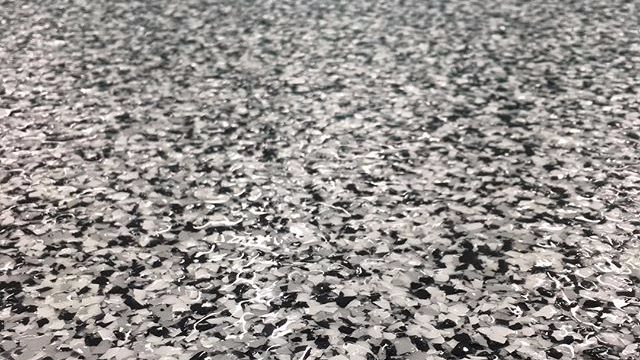
Resinous flooring has been used for many years in medical research. Resins, especially Epoxies, were brought into the US market from Europe between the 1950’s and 1970’s, and by the 1980’s, the resin market in the US was growing at a rapid pace. The first place resins were utilized in the healthcare market was in medical research because of the need for sanitation in holding rooms for animal research. Designers found that a seamless system that could take constant wash-down and high chemical attack was a perfect match for the abuse that research facilities rendered. As technology advanced in resins, different materials made their way into research facilities, but all of these products were originally thought of as functional, not architectural. In the late 1980’s, color quartz was beginning to gain popularity as a texture and color for resinous flooring systems. These types of floors were first utilized in restaurant kitchens and locker rooms, but rapidly became standard issue in research facilities. Many pharmaceutical manufactures began to use quartz flooring in their facilities because the were easy to sanitize and were less expensive than terrazzo. As manufactures started experimenting with new and more aesthetically pleasing aggregates and chips, the floors started getting the attention of designers that were seeking out a better solution for Operating rooms and Emergency rooms in healthcare facilities.

After over a decade of utilizing resin systems in OR environments, it has been proven as an over performer. The one variable that has kept it out of some designs has little to do with the material and everything to do with the installer. Unlike most finished flooring products, resinous flooring is “manufactured” on site and in place. It takes skilled labor and many man-hours to create a successful job. If the proper vetting is done prior to installation, this product is the BEST product for any OR, ER or Trauma area.
In short, this product is seamless, antimicrobial, sanitize-able, repairable, decorative, customizable, and long lasting. Even when you have to make an expansion joint, it is effectively seamless. The cove base can be any height, is a seamless part of the floor, and bonds to the wall surface (the walls can even be coated for a seamless BSL room). Many manufactures add anti-microbial additives even though bacterial has no place to grow on the surface of these products. As a designer it is important to note that not all resinous flooring systems are not created equal; do your research and make sure that the right resins are being used for the environment that they are being specified for. In all cases, these systems will out perform Vinyl flooring and should be utilized in all areas of healthcare. Hopefully there will be a day when resinous systems will be used throughout a hospital, from the OR’s and ER’s to the patient rooms and corridors. The use of these products would significantly reduce the cost of maintaining a healthcare facility due to their longevity and maintenance free finishes.
Moral:
Resinous products are superior to vinyl in almost every way. If you need help selecting the right products for your project, please email or message me. If you spend a little time up front selecting the right product, utilizing resinous products over vinyl will benefit your customer both now and over the lifetime of any healthcare design.
 Resin Adviser